
Apex Trader Funding Review: EOD Rules and Payout Limits
Affiliate disclosure: VTF may earn a commission if you purchase through the affiliate links in this review. That relationship does not change the rules described below. A referral code is not a promise of a discount; check the final order total and the terms for your exact plan.
Research checked October 6, 2026. This update uses the firm’s official pricing and help documents, with original payout calculations and AI-assisted research and drafting prepared for Verified Trader Funding. It is a desk-researched review, not a new firsthand trading or payout test. Examples are hypothetical, assume all other eligibility requirements are met, and exclude taxes and payment-provider charges. Futures trading involves risk; fees can be lost and payouts are conditional.
VTF verdict: The current EOD route can suit traders who plan around a finite payout lifecycle. Its fast evaluation path should not overshadow the funded consistency rule, safety net and closure after six payouts.
Which Apex program this review covers
Apex’s current EOD program should not be reviewed using a mixture of legacy rules and intraday-account marketing. This review concentrates on the 50K EOD evaluation and its simulated Performance Account, or PA. Intraday and older legacy accounts have separate policies. The central tradeoff is a short potential evaluation route followed by a tightly defined, finite payout lifecycle.
| 50K EOD stage | Official terms |
|---|---|
| Evaluation target / drawdown | $3,000 target; $2,000 EOD drawdown |
| Evaluation daily loss limit / positions | $1,000 daily loss limit; up to 6 contracts |
| Evaluation access | 30 days; no minimum days or consistency objective |
| Performance Account | Simulated; up to 4 contracts subject to scaling; tier-based daily loss limit |
An evaluation can be completed in one day if all conditions are met. That does not mean a new PA can pay out in one day. Official EOD evaluation terms. Official EOD PA terms.
Pricing: compare the whole route, not the sale banner
Apex offers standard evaluations with a separate activation charge and No Activation Fee evaluations with that cost built into a different purchase price. Both follow the same underlying program rules and 30-day access model. We do not quote an unredeemed JKT percentage or assume the cheapest advertised account includes activation. Official No Activation Fee explanation.
PA activation must be completed within seven calendar days after the account is marked passed. The activation is a one-time charge where applicable, not an automatically recurring subscription. Missing the deadline can mean losing the ability to activate that passed evaluation. Activation process and deadline.
Bundle economics require extra care: the five-pack access clocks start at purchase, not when you begin trading each account. If your plan is to trade one evaluation at a time over several months, a bundle with simultaneous expiry is not five sequential months of access. Official bundle terms.
Before checkout, write down the evaluation price, activation amount, expiry date and number of accounts you can realistically operate. A low per-account price can disguise a higher total amount at risk if most of a bundle is never used. No purchase was made to verify discount redemption for this review.
EOD drawdown still fails in real time
Apex calculates the EOD high-water mark at the daily close, but enforces the resulting threshold during trading, including unrealized losses. In the 50K PA, the floor eventually locks at $50,100 after the relevant $52,100 high-water mark. A daily loss limit and the maximum drawdown serve different purposes: one can pause trading, while breaching the account threshold ends the account. Official EOD drawdown explanation.
For a hypothetical initial $48,000 threshold, a trader cannot let open equity fall through that level and expect the end-of-day recovery to save the account. EOD determines when the moving floor updates, not when a breach counts. Read our drawdown guide if those two ideas have been blurred by marketing.
Payout qualification and the six-payout limit
A 50K EOD PA needs five qualifying days of at least $250, a $500 minimum request, a $52,100 safety net and at least $52,600 balance to request the minimum. The best day must be strictly below 50% of profit since the previous approved payout. The six caps are $1,500, $1,500, $2,000, $2,500, $2,500 and $3,000. After payout six, the account closes. Eligible approved payouts use a 100% trader split. Official EOD payout policy.
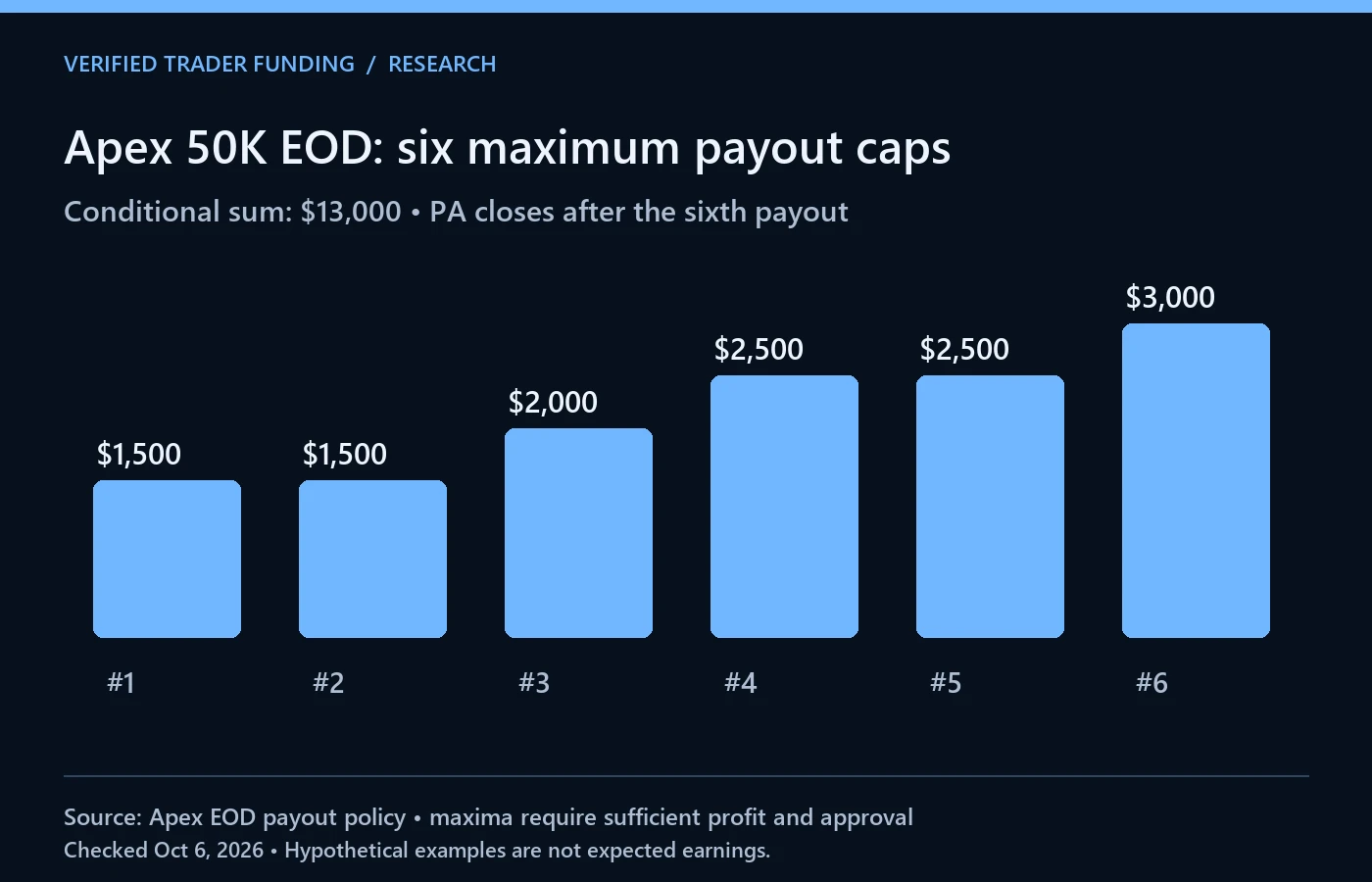
The six maxima sum to $13,000. That is a conditional ceiling obtained by adding published caps, not a forecast, success rate or promised income. An account producing smaller eligible requests can reach its sixth payout with substantially less total cash, and it still reaches the same lifecycle endpoint.
Consider a $53,000 balance at the first request. Only $900 lies above the $52,100 safety net. Even with the required days and consistency, the first $1,500 cap does not make $1,500 available. The balance gate limits the request to $900. Five $250 days also create only $1,250 profit, insufficient by themselves to reach a $52,600 minimum balance.
Do not treat the act of requesting a payout as permission to spend that balance twice. The official policy says to trade as though the requested amount is already deducted; dropping below the required amount while it is pending can cause denial. Pending-request rule.
Consistency and inactivity need different trackers
For consistency, a $1,500 best day with $3,000 cycle profit is exactly 50%, which does not satisfy a strict-below rule. Additional compliant profit is needed. This arithmetic is separate from the five qualifying days: a collection of small wins can satisfy one condition while leaving another unmet.
The new PA inactivity policy requires two days with at least $50 net profit in a rolling 30-day window. Merely opening any trade is insufficient. The policy describes irreversible closure and forfeiture after inactivity, so it should be checked before a planned break. Official inactivity policy.
A useful account journal therefore has separate fields for floor, current balance, qualifying days, best-day ratio, pending requests, payout number and inactivity dates. Combining everything into a single “passed” or “funded” badge hides the conditions that can still prevent a withdrawal.
VTF assessment and alternatives
Reasons to consider Apex EOD: no evaluation consistency target, no standalone minimum evaluation days, an EOD high-water mark and a 100% split on approved PA payouts. Tradeoffs: time-limited evaluations, activation deadlines, funded consistency, retained safety net and compulsory closure after six payouts.
The program may fit a trader who deliberately plans around finite account cycles. It is less natural for someone seeking an indefinitely retained simulated account or someone whose best days dominate their profit. The right comparison is net cash after purchase costs across the account’s lifecycle, not simply one firm’s highest payout cap.
Compare Take Profit Trader’s PRO buffer if recurring funded consistency is your main objection. Compare DayTraders Pro payout gates for a different day-count and consistency structure. Neither alternative removes trading risk or guarantees continued payouts.
Apex Trader Funding FAQ
Does the 100% payout split mean all displayed profit is withdrawable?
No. The safety net, qualifying days, consistency rule and request cap still apply. The split determines the trader’s share of an approved eligible request.
Can an EOD evaluation pass in one day?
The official evaluation has no minimum-day or consistency objective, so it can. The funded PA has separate payout qualification requirements.
Does this review apply to my legacy Apex account?
Not automatically. This review focuses on the current EOD route. Confirm the exact program and policy attached to your account rather than applying new EOD figures to a legacy or intraday account.
Before you buy
Open the Apex Trader Funding comparison profile and compare programs side by side. Check the dates on comparison snapshots: this review reflects the official documents checked above. Use our prop-firm selection guide to match the program to a process you already trade, then confirm eligibility, your platform/data costs, the account agreement, and the checkout total. Save the rules that apply to your purchase date.
View Apex Trader Funding plans through VTF’s affiliate link. VTF’s configured referral code is JKT; enter it only if the checkout provides a code field. No current discount percentage is assumed here.
Affiliate Disclosure: This post may contain affiliate links. If you sign up through our links, we may earn a commission at no extra cost to you. Each review explains its research method and evidence; affiliate compensation does not guarantee a favorable assessment.